Monday, May 26, 2014

"Our Hearts were Touched with Fire": Oliver Wendell Holmes Jr. on Memorial Day


On May 30, 1884, Oliver Wendell Holmes Jr. delivered the following remarks to the John Sedgwick Post No. 4, Grand Army of the Republic chapter. This speech is best known for Holmes's famed quote, "in our youth our hearts were touched with fire," but the entire address is noteworthy for Holmes's moving eloquence and his ability to powerfully convey the meaning behind Memorial Day. 


Holmes himself was a seasoned veteran of the Civil War, having been wounded in several engagements, including the Battle of Antietam. On the morning of September 17, 1862, Holmes's regiment, the 20th Massachusetts, was engaged in a fierce fire fight in the West Woods. Amidst the melee and confusion of battle that morning, with Confederates sweeping up the Federal flank, Holmes was wounded in the neck. His story of suffering and survival is a harrowing one, and one perhaps best told in a separate blog post. For today, Holmes's address in 1884 describing the purpose behind Memorial Day will suffice, showing how one battle scarred veteran of the war felt about remembering those who did not survive some of the worst days in the history of this nation.


Oliver Wendell Holmes Jr. (1841-1935), Associate Justice of the United States Supreme Court, veteran of the 20th Massachusetts Volunteer Infantry, and the survivor of a neck wound at the Battle of Antietam. Holmes Jr. is shown here in a photograph taken a few years before his death, sometime around 1930. 


Not long ago I heard a young man ask why people still kept up Memorial Day, and it set me thinking of the answer.  Not the answer that you and I should give to each other – not the expression of those feelings that, so long as you live, will make this day sacred to memories of love and grief and heroic youth – but an answer which should command the assent of those who do not share our memories, and in which we of the North and our brethren of the South could join in perfect accord.

So far as this last is concerned, to be sure, there is no trouble.  The soldiers who were doing their best to kill one another felt less of personal hostility, I am very certain, than some who were not imperilled by their mutual endeavors.  I have heard more than one of those who had been gallant and distinguished officers on the Confederate side say that they had had no such feeling.  I know that I and those whom I knew best had not. We believed that it was most desirable that the North should win; we believed in the principle that the Union is indissoluable; we, or many of us at least, also believed that the conflict was inevitable, and that slavery had lasted long enough.  But we equally believed that those who stood against us held just as sacred conviction that were the opposite of ours, and we respected them as every man with a heart must respect those who give all for their belief.  The experience of battle soon taught its lesson even to those who came into the field more bitterly disposed.  You could not stand up day after day in those indecisive contests where overwhelming victory was impossible because neither side would run as they ought when beaten, without getting at least something of the same brotherhood for the enemy that the north pole of a magnet has for the south–each working in an opposite sense to the other, but each unable to get along without the other.  As it was then, it is now.  The soldiers of the war need no explanations; they can join in commemorating a soldier’s death with feelings not different in kind, whether he fell toward them or by their side.

But Memorial Day may and ought to have a meaning also for those who do not share our memories.  When men have instinctively agreed to celebrate an anniversary, it will be found that there is some thought of feeling behind it which is too large to be dependent upon associations alone.  The Fourth of July, for instance, has still its serious aspect, although we no longer should think of rejoicing like children that we have escaped from an outgrown control, although we have achieved not only our national but our moral independence and know it far too profoundly to make a talk about it, and although an Englishman can join in the celebration without a scruple.  For, stripped of the temporary associations which gives rise to it, it is now the moment when by common consent we pause to become conscious of our national life and to rejoice in it, to recall what our country has done for each of us, and to ask ourselves what we can do for the country in return.

So to the indifferent inquirer who asks why Memorial Day is still kept up we may answer, it celebrates and solemnly reaffirms from year to year a national act of enthusiasm and faith.  It embodies in the most impressive form our belief that to act with enthusiam and faith is the condition of acting greatly.  To fight out a war, you must believe something and want something with all your might. So must you do to carry anything else to an end worth reaching.  More than that, you must be willing to commit yourself to a course, perhaps a long and hard one, without being able to foresee exactly where you will come out.  All that is required of you is that you should go somewhither as hard as ever you can.  The rest belongs to fate. One may fall at the beginning of the charge or at the top of the earthworks; but in no other way can he reach the rewards of victory.

When it was felt so deeply as it was on both sides that a man ought to take part in the war unless some conscientious scruple or strong practical reason made it impossible, was that feeling simply the requirement of a local majority that their neighbors should agree with them?  I think not: I think the feeling was right – in the South as in the North.  I think that, as life is action and passion, it is required of a man that he should share the passion and action of his time at peril of being judged not to have lived.

If this be so, the use of this day is obvious.  It is true that I cannot argue a man into a desire.  If he says to me, “Why should I seek to know the secrets of philosophy? Why seek to decipher the hidden laws of creation that are graven upon the tablets of the rocks, or to unravel the history of civilization that is woven in the tissue of our jurisprudence, or to do any great work, either of speculation or of practical affairs?”, I cannot answer him; or at least my answer is as little worth making for any effect it will have upon his wishes if he asked why I should eat this, or drink that.  You must begin by wanting to. But although desire cannot be imparted by argument, it can be by contagion. Feeling begets feeling, and great feeling begets great feeling.  We can hardly share the emotions that make this day to us the most sacred day of the year, and embody them in ceremonial pomp, without in some degree imparting them to those who come after us.  I believe from the bottom of my heart that our memorial halls and statues and tablets, the tattered flags of our regiments gathered in the Statehouses, are worth more to our young men by way of chastening and inspiration than the monuments of another hundred years of peaceful life could be.

But even if I am wrong, even if those who come after us are to forget all that we hold dear, and the future is to teach and kindle its children in ways as yet unrevealed, it is enough for us that this day is dear and sacred.

Accidents may call up the events of the war.  You see a battery of guns go by at a trot, and for a moment you are back at White Oak Swamp, or Antietam, or on the Jerusalem Road.  You hear a few shots fired in the distance, and for an instant your heart stops as you say to yourself, “The skirmishers are at it”, and listen for the long roll of fire from the main line.  You meet an old comrade after many years of absence; he recalls the moment that you were nearly surrounded by the enemy, and again there comes up to you that swift and cunning thinking on which once hung life and freedom – “Shall I stand the best chance if I try the pistol or the saber on that man who means to stop me? Will he get his carbine free before I reach him, or can I kill him first?”  These and the thousand other events we have known are called up, I say, by accident, and, apart from accident, they lie forgotten.

But as surely as this day comes round we are in the presence of the dead.  For one hour, twice a year at least – at the regimental dinner, where the ghosts sit at table more numerous than the living, and on this day when we decorate their graves – the dead come back and live with us.

I see them now, more than I can number, as once I saw them on this earth.  They are the same bright figures, or their counterparts, that come also before your eyes; and when I speak of those who were my brothers, the same words describe yours.

I see a fair-haired lad, a lieutenant, and a captain on whom life had begun somewhat to tell, but still young, sitting by the long mess-table in camp before the regiment left the State, and wondering how many of those who gathered in our tent could hope to see the end of what was then beginning.  For neither of them was that destiny reserved.  I remember, as I awoke from my first long stupor in the hospital after the battle of Ball’s Bluff, I heard the doctor say, “He was a beautiful boy”, and I knew that one of those two speakers was no more. The other, after passing through all the previous battles, went into Fredericksburg with a strange premonition of the end, and there met his fate.

I see another youthful lieutenant as I saw him in the Seven Days, when I looked down the line at Glendale.  The officers were at the head of their companies. The advance was beginning. We caught each other’s eye and saluted. When next I looked, he was gone.

I see the brother of the last – the flame of genius and daring on his face – as he rode before us into the wood of Antietam, out of which came only dead and deadly wounded men.  So, a little later, he rode to his death at the head of his cavalry in the Valley.

In the portraits of some of those who fell in the civil wars of England, Vandyke has fixed on canvas the type who stand before my memory.  Young and gracious faces, somewhat remote and proud, but with a melancholy and sweet kindness.  There is upon their faces the shadow of approaching fate, and the glory of generous acceptance of it. I may say of them, as I once heard it said of two Frenchmen, relics of the ancien regime, “They were very gentle. They cared nothing for their lives.”  High breeding, romantic chivalry – we who have seen these men can never believe that the power of money or the enervation of pleasure has put an end to them.  We know that life may still be lifted into poetry and lit with spiritual charm.

But the men, not less, perhaps even more, characteristic of New England, were the Puritans of our day.  For the Puritan still lives in New England, thank God! and will live there so long as New England lives and keeps her old renown.  New England is not dead yet.  She still is mother of a race of conquerors–stern men, little given to the expression of their feelings, sometimes careless of their graces, but fertile, tenacious, and knowing only duty.  Each of you, as I do, thinks of a hundred such that he has known.  I see one – grandson of a hard rider of the Revolution and bearer of his historic name – who was with us at Fair Oaks, and afterwards for five days and nights in front of the enemy the only sleep that he would take was what he could snatch sitting erect in his uniform and resting his back against a hut. He fell at Gettysburg.  His brother , a surgeon, who rode, as our surgeons so often did, wherever the troops would go, I saw kneeling in ministration to a wounded man just in rear of our line at Antietam, his horse’s bridle round his arm–the next moment his ministrations were ended. His senior associate survived all the wounds and perils of the war, but, not yet through with duty as he understood it, fell in helping the helpless poor who were dying of cholera in a Western city.

I see another quiet figure, of virtuous life and quiet ways, not much heard of until our left was turned at Petersburg.  He was in command of the regiment as he saw our comrades driven in.  He threw back our left wing, and the advancing tide of defeat was shattered against his iron wall. He saved an army corps from disaster, and then a round shot ended all for him.

There is one who on this day is always present on my mind.  He entered the army at nineteen, a second lieutenant.  In the Wilderness, already at the head of his regiment, he fell, using the moment that was left him of life to give all of his little fortune to his soldiers.  I saw him in camp, on the march, in action.  I crossed debatable land with him when we were rejoining the Army together. I observed him in every kind of duty, and never in all the time I knew him did I see him fail to choose that alternative of conduct which was most disagreeable to himself.  He was indeed a Puritan in all his virtues, without the Puritan austerity; for, when duty was at an end, he who had been the master and leader became the chosen companion in every pleasure that a man might honestly enjoy. His few surviving companions will never forget the awful spectacle of his advance alone with his company in the streets of Fredericksburg.  In less than sixty seconds he would become the focus of a hidden and annihilating fire from a semicircle of houses. His first platoon had vanished under it in an instant, ten men falling dead by his side. He had quietly turned back to where the other half of his company was waiting, had given the order, “Second Platoon, forward!” and was again moving on, in obedience to superior command, to certain and useless death, when the order he was obeying was countermanded.  The end was distant only a few seconds; but if you had seen him with his indifferent carriage, and sword swinging from his finger like a cane, you would never have suspected that he was doing more than conducting a company drill on the camp parade ground.  He was little more than a boy, but the grizzled corps commanders knew and admired him; and for us, who not only admired, but loved, his death seemed to end a portion of our life also.

There is one grave and commanding presence that you all would recognize, for his life has become a part of our common history.  Who does not remember the leader of the assault of the mine at Petersburg? The solitary horseman in front of Port Hudson, whom a foeman worthy of him bade his soldiers spare, from love and admiration of such gallant bearing? Who does not still hear the echo of those eloquent lips after the war, teaching reconciliation and peace? I may not do more than allude to his death, fit ending of his life. All that the world has a right to know has been told by a beloved friend in a book wherein friendship has found no need to exaggerate facts that speak for themselves. I knew him, and I may even say I knew him well; yet, until that book appeared, I had not known the governing motive of his soul. I had admired him as a hero. When I read, I learned to revere him as a saint. His strength was not in honor alone, but in religion; and those who do not share his creed must see that it was on the wings of religious faith that he mounted above even valiant deeds into an empyrean of ideal life.

I have spoken of some of the men who were near to me among others very near and dear, not because their lives have become historic, but because their lives are the type of what every soldier has known and seen in his own company. In the great democracy of self-devotion private and general stand side by side. Unmarshalled save by their own deeds, the army of the dead sweep before us, “wearing their wounds like stars.” It is not because the men I have mentioned were my friends that I have spoken of them, but, I repeat, because they are types. I speak of those whom I have seen. But you all have known such; you, too, remember!

It is not of the dead alone that we think on this day. There are those still living whose sex forbade them to offer their lives, but who gave instead their happiness. Which of us has not been lifted above himself by the sight of one of those lovely, lonely women, around whom the wand of sorrow has traced its excluding circle–set apart, even when surrounded by loving friends who would fain bring back joy to their lives? I think of one whom the poor of a great city know as their benefactress and friend. I think of one who has lived not less greatly in the midst of her children, to whom she has taught such lessons as may not be heard elsewhere from mortal lips. The story of these and her sisters we must pass in reverent silence. All that may be said has been said by one of their own sex -

But when the days of golden dreams had perished,
And even despair was powerless to destroy,
Then did I learn how existence could be cherished,
Strengthened, and fed without the aid of joy.
Then did I check the tears of useless passion,
weaned my young soul from yearning after thine
Sternly denied its burning wish to hasten
Down to that tomb already more than mine.

Comrades, some of the associations of this day are not only triumphant, but joyful.  Not all of those with whom we once stood shoulder to shoulder–not all of those whom we once loved and revered–are gone.  On this day we still meet our companions in the freezing winter bivouacs and in those dreadful summer marches where every faculty of the soul seemed to depart one after another, leaving only a dumb animal power to set the teeth and to persist – a blind belief that somewhere and at last there was bread and water.  On this day, at least, we still meet and rejoice in the closest tie which is possible between men – a tie which suffering has made indissoluble for better, for worse.

When we meet thus, when we do honor to the dead in terms that must sometimes embrace the living, we do not deceive ourselves.  We attribute no special merit to a man for having served when all were serving.  We know that, if the armies of our war did anything worth remembering, the credit belongs not mainly to the individuals who did it, but to average human nature.  We also know very well that we cannot live in associations with the past alone, and we admit that, if we would be worthy of the past, we must find new fields for action or thought, and make for ourselves new careers.

But, nevertheless, the generation that carried on the war has been set apart by its experience.  Through our great good fortune, in our youth our hearts were touched with fire.  It was given to us to learn at the outset that life is a profound and passionate thing. While we are permitted to scorn nothing but indifference, and do not pretend to undervalue the worldly rewards of ambition, we have seen with our own eyes, beyond and above the gold fields, the snowy heights of honor, and it is for us to bear the report to those who come after us.  But, above all, we have learned that whether a man accepts from Fortune her spade, and will look downward and dig, or from Aspiration her axe and cord, and will scale the ice, the one and only success which it is his to command is to bring to his work a mighty heart.

Such hearts – ah me, how many! – were stilled twenty years ago; and to us who remain behind is left this day of memories. Every year – in the full tide of spring, at the height of the symphony of flowers and love and life – there comes a pause, and through the silence we hear the lonely pipe of death. Year after year lovers, wandering under the apple trees and through the clover and deep grass, are surprised with sudden tears as they see black veiled figures stealing through the morning to a soldier’s grave. Year after year the comrades of the dead follow, with public honor, procession and commemorative flags and funeral march – honor and grief from us who stand almost alone, and have seen the best and noblest of our generation pass away.

But grief is not the end of all. I seem to hear the funeral march become a paean. I see beyond the forest the moving banners of a hidden column. Our dead brothers still live for us, and bid us think of life, not death – of life to which in their youth they lent the passion and joy of the spring. As I listen, the great chorus of life and joy begins again, and amid the awful orchestra of seen and unseen powers and destinies of good and evil our trumpets sound once more a note of daring, hope, and will.


Dan Vermilya

Park Ranger


Friday, May 23, 2014

Memorial Day Weekend at Antietam National Cemetery

Every year, local school children visit the Antietam National Cemetery in Sharpsburg, Maryland just before Memorial Day weekend to pay homage to those who gave their lives during the American Civil War. The students visit the cemetery to place small American flags next to the graves of American soldiers killed during the 1862 Battle of Antietam, the Battle of South Mountain, and some of those killed in the 1864 Battle of Monocacy, which took place just south of Frederick, Maryland. From these battles, there are 4,776 Civil War dead interred in the cemetery. The students also place flags next to the graves of those who have been killed in America's 20th century conflicts, as well as those who served in foreign wars and who are interred in the National Cemetery. While the cemetery was closed for further burials years ago, the most recent interment is that of Patrick Roy, a US Sailor killed in the terrorist attack on the USS Cole in 2000.


This act of placing flags next to graves in the cemetery lies at the heart of Memorial Day, a holiday which began in the immediate aftermath of the Civil War. From its origins, Memorial Day was meant to be a day honoring those who died in service of their country. When young students visit the cemetery each May to place flags next to the graves of American soldiers, they are fulfilling the true purpose of Memorial Day. They are pausing to say thank you for the sacrifices made many years ago by men they never knew, who, as Lincoln said at Gettysburg, "here gave their lives that that nation might live."


Here are a few images of the activities this morning in the Antietam National Cemetery...


"Old Simon" stands watch over the National Cemetery...


SCA Education Intern Mark Chaney assists the students with placing flags.


A few of the students who helped place the flags in the National Cemetery this morning...


Color Sergeant George Simpson, 125th PA, who was killed at Antietam while holding his regiment's flag, staining it with his blood, has his grave decorated with an American flag just in time for Memorial Day...


Perhaps the most fitting conclusion is found in the words of Abraham Lincoln's Gettysburg Address, which is posted inside the Antietam National Cemetery, describing the meaning of the sacrifice made by so many Americans through this nation's history...


Four score and seven years ago our fathers brought forth on this continent, a new nation, conceived in Liberty, and dedicated to the proposition that all men are created equal. Now we are engaged in a great civil war, testing whether that nation, or any nation so conceived and so dedicated, can long endure. We are met on a great battle-field of that war. We have come to dedicate a portion of that field, as a final resting place for those who here gave their lives that that nation might live. It is altogether fitting and proper that we should do this. But, in a larger sense, we can not dedicate — we can not consecrate — we can not hallow — this ground. The brave men, living and dead, who struggled here, have consecrated it, far above our poor power to add or detract. The world will little note, nor long remember what we say here, but it can never forget what they did here. It is for us the living, rather, to be dedicated here to the unfinished work which they who fought here have thus far so nobly advanced. It is rather for us to be here dedicated to the great task remaining before us — that from these honored dead we take increased devotion to that cause for which they gave the last full measure of devotion — that we here highly resolve that these dead shall not have died in vain — that this nation, under God, shall have a new birth of freedom — and that government of the people, by the people, for the people, shall not perish from the earth.


Dan Vermilya
Park Ranger

Monday, March 31, 2014

Sunken Road Hike


Join us on Sunday, April 6th for a ranger-led hike exploring the fighting and terrain of the Sunken Road phase of the battle of Antietam.

Join Park Ranger Brian Baracz at 1:00 at the visitor center.  Sturdy footwear is recommended.


See you there!

Tuesday, March 4, 2014

"Civil War:The Untold Story" to premier at Antietam


Antietam National Battlefield Presents Sneak-

Preview Screenings Of “Civil War: The Untold 

Story”

Subscribe RSS Icon | What is RSS
Date: February 4, 2014
Civil War: The Untold Story is a visually stunning new 5-part documentary series narrated by Elizabeth McGovern (Downton Abbey) and produced for public television by Great Divide Pictures.  Antietam National Battlefield in partnership with the Washington County Free Library and the Heart of the Civil War Heritage Area will premiere the series on Thursday nights, March 13, 20 and 27 at 7:00 pm at the park visitor center. The series breaks new ground by examining the war through the lens of the Western Theater – including critical yet lesser-known battles of Shiloh, Vicksburg, Chickamauga, and Atlanta. Filmed with sweeping cinematic style on the very grounds where these epic battles were fought, it recreates authentic scenes and features interviews with top historians to provide new insights on the war and the relatively unknown roles that African Americans played in the conflict, from enslaved to emancipated to soldier. 
The series is produced and directed by Chris Wheeler of Great Divide Pictures (greatdividepictures.com). For more than 20 years, Great Divide has been producing award-winning historical documentaries including:How the West Was Lost, Our Time in Hell: the Korean War, and Godspeed, John Glenn which was narrated by Walter Cronkite. Additionally, Great Divide has recently produced Visitor Center films for more than 25 National Parks, including Shiloh National Military Park, Chickamauga/Chattanooga National Military Park, and Kennesaw Mountain National Battlefield Park.
Parts 1 and 2 will premiere on March 13. Parts 3 and 4 will be shown on March 20. On March 27, Part 5 will be shown and the film's producer Chris Wheeler will speak about his project.
"The film is not just about who we were then. It's about who we are now," said producer Chris Wheeler. "In a nation arguably as divided today as we were 150 years ago, Civil War: The Untold Story is a compelling, relevant program that we believe will strike a powerful chord with Americans today." Interspersed are compelling on-camera interviews with some of America's top Civil War historians – including Allen Guelzo, Henry R. Luce Professor of the Civil War Era at Gettysburg College; Peter Carmichael, Robert C. Fluhrer Professor of Civil War Studies at Gettysburg College; Amy Murrell Taylor, Associate Professor of History at the University of Kentucky; and Stacy Allen, the Chief Historian at Shiloh National Military Park.
Episode One – Bloody Shiloh With the 1860 election of anti-slavery candidate Abraham Lincoln, thirteen states from the South secede and form the Confederate States of America. Union military leaders, along with Lincoln himself, realize that ending the rebellion rests on controlling the Mississippi River. In February 1862, Union forces, led by an obscure general named Ulysses S. Grant, establish a foothold in southern Tennessee near a simple log structure known as "Shiloh Church." On April 6, 1862, a Confederate force of over 40-thousand, led by General Albert Sidney Johnston, launch a surprise attack on Grant. The fighting in the hellish terrain surrounding Shiloh is some of the most brutal of the entire war. By day's end, victory is in sight for the attacking Confederates. But Johnston has been struck in the leg by a bullet, and bleeds to death in 20 minutes. The death of Johnston is a harbinger of a great change that will soon sweep over "Bloody Shiloh."
Episode Two – A Beacon of Hope In the disaster at Shiloh, Union General Ulysses S. Grant sees victory. On the night of April 6, 1862, Grant's beleaguered army along the Tennessee River is reinforced. The next morning, Grant's counterattack leads to victory. The defeated Confederate force of 40- thousand retreats south to Corinth, Mississippi. At Shiloh, the Confederates lose arguably their best opportunity to change the outcome of the war. The shocking combined casualties of 24-thousand men is more than in all the wars fought to that date in the United States. Many of the nearly 4 million slaves across the South see the war as an opportunity to seize their own destiny. Thousands of escaping slaves, dubbed 'contrabands', seek refuge with Union forces advancing into the South. At Corinth, Mississippi, the Union army sets up a 'contraband camp.' The former slaves begin building a community that includes a school, hospital, and church. As thousands of slaves flee northward, the question asked all over America is this: are they still slaves or are they now free? In a cottage overlooking Washington DC, Abraham Lincoln begins drafting a "proclamation" whose message will boldly answer that question.
Episode Three – River of Death Abraham Lincoln's Emancipation does not only free slaves in the rebelling states. It changes the war from one of reunification, to one of ending slavery. The Emancipation Proclamation also gives African Americans freedom to fight. By war's end, some 200,000 will enlist. In truth, Lincoln's proclamation is an empty promise without the power of the United States Army to enforce it. In 1863, Ulysses S. Grant begins a campaign to take Vicksburg, Mississippi, a Confederate citadel overlooking a strategic section of the lower Mississippi River. In May, Grant begins laying siege to the city of 4500. Mary Loughborough is one of the many terrified civilians who have dug caves into the hillsides for protection. Clutching her 2-year old daughter, Mary "endeavored by constant prayer to prepare myself for the sudden death I was almost certain awaited me." On July 4, 1863 – the day after Pickett's disastrous charge at Gettysburg – the Confederates surrender Vicksburg to Grant. With the Mississippi River now under Union control, the campaign moves eastward to Chattanooga, Tennessee, a rail center that Lincoln considers to be as important as the Confederate capital of Richmond. Eight miles south, along the Chickamauga - a creek the Cherokee call "the river of death" - Union and Confederate forces clash in what will become the biggest battle of the Western Theater.
Episode Four – Death Knell of the Confederacy September 19, 1863. The first day of the Battle of Chickamauga ends in a bloody draw. On the next day, the battle is determined by one of the biggest blunders of the Civil War. Miscommunication, confusion, and fatigue with Union General William Rosecrans and his generals have left a gap in the Union line more than a quarter mile wide. James Longstreet's force of 11,000 from the Confederate Army of Northern Virginia, pour through the gap and split the Union army in two. Rosecrans and his beaten army escape to Chattanooga. Chickamauga's combined casualties of 34,000 are only topped by the carnage at Gettysburg. In October, Rosecrans is replaced by U.S. Grant, who immediately plans an offensive. In November 1863, Grant routes the Confederate stronghold just outside Chattanooga. As they escape southward into Georgia, a Confederate officer calls the devastating defeat: "the death knell of the Confederacy."
Episode Five – With Malice Toward None In the spring of 1864, General William Tecumseh Sherman's force of 100-thousand men marches from Chattanooga toward Atlanta, Georgia, the industrial hub of the Deep South. Twenty miles north of Atlanta, Sherman's army is soundly defeated at Kennesaw Mountain. Sherman's defeat combined with Grant's stalemate in Virginia, enrages a Northern electorate already weary of war. The presidential election is in November, and Abraham Lincoln's chances for a second term are dwindling by the day. The Democrats nominate George McClellan. The party's platform calls for a negotiated peace with the Confederacy in which slaveholders will be allowed to keep their property. If McClellan is elected, Lincoln's Emancipation Proclamation will almost certainly be struck down. Though victorious at Kennesaw Mountain, the outnumbered Confederate Army falls back to a defensive position at Atlanta. After 6 weeks of bloody conflicts around Atlanta, Sherman wires Washington: "Atlanta is ours and fairly won." For the first time in the war, many in the North now believe victory can be achieved. Eight weeks later, the president defeats McClellan in a landslide. After the election, Sherman begins his March to the Sea. The largely unopposed march across Georgia to Savannah is a psychological blow to the Confederacy, and a stunning conclusion to the Western Theater.
To view video clips, images and additional information on Civil War: The Untold Story, follow the series on Facebook: https://www.facebook.com/CivilWarTheUntoldStory .

Monday, December 2, 2013

Tuesday, October 22, 2013

Battlefield Burials by Alann Schmidt


Battlefield Burials After Antietam:  A Most Disagreeable Duty

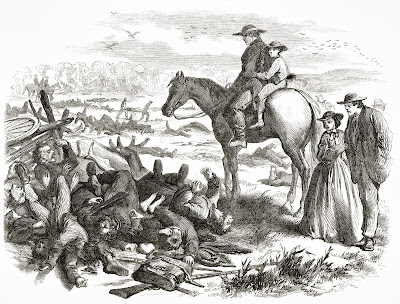
Chief among the many long-lasting impacts of the Battle of Antietam is the sheer enormity of tragedy and loss.  September 17, 1862 still ranks as the most casualties in one day, in one place, in the history of the United States of America – over 23,000 killed, wounded, and missing.  Often overlooked is what happens after the fighting ceases, as the glory of battle gives way to an unpleasant, practical reality.  In addition to the medical care of thousands of wounded soldiers, the massive task of burying thousands of the dead would have to be completed.


As the first field to be photographed soon after the battle, images such as these show the horrific scope of the fight.  The Union army held the field, so many in the ranks would need to be put into burial parties and quickly get to work.  Even so, it would take days to complete such a grisly job. 


“Our regiment has been detailed to bury the dead, the most disagreeable duty that could have been assigned to us; tongue cannot describe the horrible sights which we have witnessed.  The Union soldiers were all buried when we arrived on the field, the rebel dead lay unburied and hundreds still remain so.  I would not describe to you the appearance of the dead even if I could, it is too revolting.  You can imagine the condition of the bodies when I tell you that they were slain on Wednesday and it is now Sunday.  I was up at the Provost Marshall’s office this morning for permission to buy some liquor for our boys to keep them from getting sick when at this disagreeable labor.”

                                                                                                    --Lt. Origen Bingham, 137th PA


Some burials were individual graves, but many were simply long trenches to hold multiple bodies.  All those killed were buried, but obviously the Union soldiers took care of their comrades first.  Taken two days after the battle, most, if not all, of the dead seen in photos would have been Confederates.  Identification was often difficult, and information on headboards and markings was mostly limited.  There were even reports of grave looting.


“Every man’s pocket was turned inside out.  Sometimes a piece of money, a pocket knife, or something else would fall from the hands of the midnight robbers, in the dark, and we would find it where they had turned the pocket, but every one was robbed by the ghouls.  Well, we had the dead to bury, thousands of them… it was the most disagreeable days work of my life.  First the grave had to be dug.  You Elkton folks saw the workmen dig for the water-works pipe – now add a few thousand additional workmen, and extend the ditch about six miles, and make it two or three feet wider and deeper.  Now look in every direction and see hundreds carrying the mangled bodies of those who had been shot.”

                                                                                                         -J. Polk Racine, 5th MD


Obviously these were terribly unpleasant conditions, and the warm weather lingered into late September.  Contact with dead bodies would also be a serious health hazard, as soldiers who came from all over the country brought various diseases with them.  Disease killed many more soldiers than any battle, and the local civilians were very susceptible as well.  No civilians were wounded or injured during the battle, but many died from rampant disease in the weeks and months following.  The full story of the many battle impacts on the Sharpsburg area is best left for another complete blog entry, but notable for our purposes is the simple fact that many of the farmer’s fields became giant cemeteries, greatly impacting their agricultural operations for years to come.

News of the battle quickly spread across the country.  Tourists came to see the battlefield, and many family members came to care for and take their loved ones back home.


Among the many who came to visit the battlefield was a young wife whose frantic grief I can never forget.  She came hurriedly as soon as she knew her husband was in the battle only to find him dead and buried two days before her arrival.  Unwilling to believe the facts strangers told her – how early in the morning they had laid him beside his comrades in the orchard – she still insisted upon seeing him.  Accompanying some friends to the spot she could not wait the slow process of removing the body, and in her agonizing grief clutched the earth by handfuls where it lay upon the quiet sleeper’s form.  And when at length the slight covering was removed and the blanket thrown from off the face, she needed but one glance to assure her it was all too true.  Then passive and quiet beneath the stern reality of this crushing sorrow she came back to the room in our house.

                                                                                                         -Antietam Valley Record


Local man Aaron Good thankfully took upon himself the task of identifying and documenting as many gravesites as he could.  This record became essential in later planning for a proper cemetery, and he also was often contracted to find the grave of a soldier and ship the body back home.  The following letter, on display in the Antietam Visitor Center museum, was sent to Good thanking him for his efforts.

New York
85 W. 26th St.
4 June 1863

Mr. Aaron Good

Dear Sir,

We received the remains of our son George Wilson (who fell at the Battle of Antietam on Sept. 17th 1862) on last Friday evening at 6 o’clock, but had got a letter in the morning notifying us of their coming.  On their arrival we felt satisfied that you had transacted your part of the contract faithfully and honorably, and likewise felt happy to see that you had paid that respect to the remains of one whom we had loved so dearly and had built our future hopes on more than we can describe at present.

If this communication can be of any service in inducing others to bring home the remains of their relatives we consider it our duty to certify through this how we appreciate your kindness in fulfilling your share of our most anxious hopes, with the assurance that they may place all confidence in you and the expeditious manner in which everything had been arranged to our entire satisfaction.

George & Margaret Wilson


As time passed, folks did their best to get back to their normal daily routine, but in some ways the situation around Sharpsburg did not improve.  Most of the burials were not quality work, not very deep, and even were sometimes just dirt piled up on top of the ground.  It did not take long until heavy rainstorms and animals took their toll, and exposed bones were a common sight.  Local citizens continued to contact their state representatives to try to get something done, but it took until March 1864 for the Maryland General Assembly to approve an act to establish an official soldier’s cemetery at Sharpsburg.  A board was appointed and work soon got started to relocate the dead of the Battle of Antietam.

Finally the farmers of the area would have their fields back, and more importantly, the men who sacrificed all for their country would finally have a more appropriate, respectful resting place.  The story of the battlefield burials after the Battle of Antietam is an unpleasant, grisly, if not also fascinating topic, but we must make sure that we remember that each one of the over 23,000 casualties was a person, and as one who paid the ultimate price in service to their country, a person to be remembered and honored.

“Here lie men who have not hesitated to seal and stamp their convictions with their blood – men who have flung themselves into the great gulf of the unknown to teach the world that there are truths dearer than life, wrongs and shames more to be dreaded than death.  And if there be on earth one spot where the grass will grow greener than on another when the next summer comes, where the leaves of autumn will drop more lightly when they fall like  benediction upon a work completed and a promise fulfilled, it is these soldiers graves.”

                                                                                        New York Times, October 20, 1862